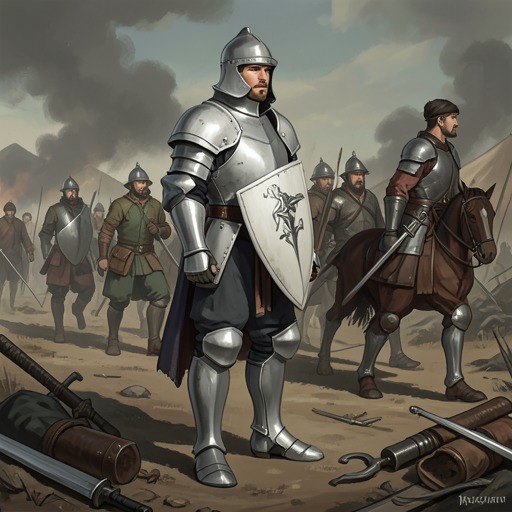
Shield Colors as Signs of Allegiance
De brief voor de KoningShield colors are visible signs of political affiliation and authority, most decisively through the white shields carried by the knights of Unauwen. Their meaning is not merely decorative: a shield can identify a pursued knight, expose the reach of a conflict beyond one kingdom, and, when given to Tiuri, bind his new knighthood to a mission inherited from another man. Other colors appear in the same world, but the story gives the white shield the clearest and most consequential meaning.
Heraldic Signs and Shared History
The white shield is introduced as a customary mark of Unauwen’s knights. When Tiuri explains that the Red Riders from Eviellan pursued a knight of Unauwen, his listeners try to identify the man as Andomar of Ingwel. Tiuri does not disclose the knight’s name. He describes only a knight with a white shield, and the innkeeper observes that all the king’s knights carry white shields. The emblem therefore identifies a political allegiance while leaving the individual concealed. For Tiuri, that distinction is essential: he has been told to keep his mission secret and withholds both the knight’s identity and the fact that the Red Riders murdered him until he can report to King Unauwen.
The emblem’s legibility rests on an older account of relations between the two realms. Piak is told that, centuries earlier, knights of Unauwen crossed the mountains into Dagonaut, founded villages and castles, taught the local people what they knew, and gave them their language. The account further says that they may have founded the City of Dagonaut and that Dagonaut’s kings and knights descend from them. Tiuri says he has never heard this history. It is presented as a claim about shared origins, not as proof that the kingdoms remain politically united. The white shield can thus signify a distinct allegiance within a region whose traditions are said to be intertwined.
Colors in a Contested Political Landscape
The Red Riders’ color carries a different association. Tiuri identifies them as riders from Eviellan serving a Black Knight with a Red Shield. One of his listeners recognizes the knight as a man of the Lord of Eviellan. Tiuri stresses that the riders had no rightful business in Dagonaut: they were pursuing a knight of Unauwen. The contrast between the white shield and the red one makes the conflict’s alignments visible, while the pursuit itself shows those alignments crossing a kingdom’s borders. A color identifies a side, but the circumstances reveal what that side is doing.
The rainbow-colored shield belongs to a different setting and function. At the barrier before the bridge, Tiuri and Piak see a guard wearing a helmet and carrying a spear and a shield displaying all the colors of the rainbow. A mounted traveler is allowed through after speaking with the guard, who then closes the barrier again. Later, when a boat reaches the friends on the river, its commander is recognized as Warmin, the guard they had met on the bank the previous afternoon. Warmin announces that they are prisoners of the toll lord for trying to evade the toll. The narrative associates the many-colored shield with the guarded crossing and its official, but does not explain it as a sign of allegiance equivalent to Unauwen’s white shields.
Rings offer a related, more explicitly enumerated system of affiliation. When the toll lord sees Tiuri’s ring, he explains that there are twelve such rings: two alike were given by King Unauwen to his sons, five were given to the king’s knights, and five to the lords of the bridges and rivers. Tiuri recalls that Ewijn had described such rings as gifts to the king’s most faithful paladins. The distribution connects the royal family, trusted knights, and officials who control crossings. Unlike the shields, the rings are counted and allocated by the king; together, the two kinds of insignia make allegiance and delegated authority recognizable in different ways.
Tiuri’s White Shield
Before the ceremonial splendor of knighting, candidates undergo a night of fasting and vigil in a small chapel outside the city. Their swords lie before the altar as they kneel in white garments, reflect on their task, and promise to serve Dagonaut’s king and realm faithfully, to be honest and helpful, and to fight for what is good. The vigil gives the later shield a context of chosen duty: the outward sign follows an inward commitment, even though the candidates do not yet carry it as knights.
Tiuri’s own white shield makes that connection unusually explicit. After he delivers his mission and fulfills his promise to Edwinem, King Dagonaut tells him that his actions have already shown him to be a knight, even before the king strikes him with a sword. The king then knights him and gives him a shield as white as snow. Tiuri is to promise loyalty to Dagonaut, but the shield also marks him as a servant of Unauwen, at that king’s request, and recalls the knight whose task Tiuri took over. The emblem therefore does not erase Tiuri’s service to his own king; it holds two obligations together and keeps the inherited mission present within his new status.
Meaning and Narrative Consequence
The story gives shield color practical force before giving it ceremonial force. The white shield lets Tiuri refer to the murdered knight without identifying him, preserving secrecy while telling listeners which king’s servant had been hunted. The red shield and Red Riders, meanwhile, point toward Eviellan’s involvement in a pursuit that violates Dagonaut’s borders. These signs do not disclose every fact on their own: Tiuri’s careful omission demonstrates how an emblem can reveal allegiance while leaving identity and circumstances unspoken.
At the end of Tiuri’s vigil, the white shield hangs above the altar as he recognizes that the journey has changed him and that knighthood is only beginning. Its significance is consequently both political and personal. It identifies a connection between kingdoms, commemorates the predecessor whose work Tiuri completed, and gives visible form to a commitment that his conduct had already established. The story’s strongest use of heraldic color is not a fixed key in which every hue receives an explained meaning, but the white shield’s capacity to carry several loyalties and histories at once.